


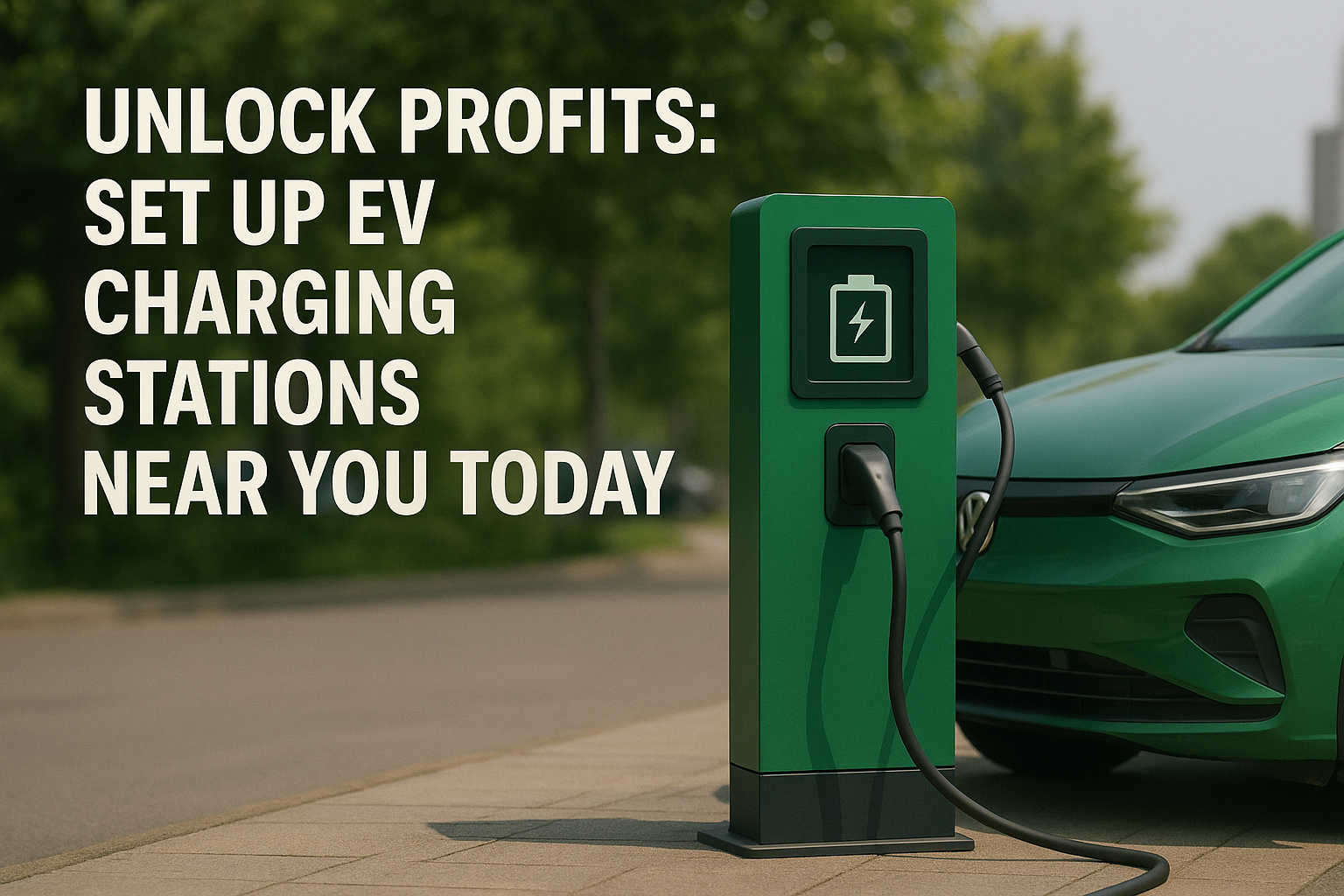
Capitalise on the Surge: Establish Profitable EV Charging Stations Near You
India’s electric-mobility wave is turning every kerbside, mall car park, office basement and highway lay-by into a potential micro power business. As more motorists tap “EV charging stations near me”, you can position your land parcel, hospitality venue or fleet depot as the answer. By installing AC destination chargers for leisurely top-ups alongside rapid DC units for time-pressed drivers, you earn from both dwell time and urgent range needs. The country’s expanding public-charging network drives footfall and unlocks a fresh, infrastructure-backed revenue stream that rewards proactive investors with predictable utilisation and scalable margins.
You now stand at the threshold of an energy transition that favours entrepreneurs who marry real-estate access with smart hardware, software and customer engagement. Public chargers already influence where commuters shop, where families dine and which highways truckers select. When you brand a convenient, reliable station as the ‘nearest EV charging point’, you cement loyalty early, harvest on-site spending and future-proof your property portfolio against the combustion engine’s decline. The guide below walks you through location selection, revenue forecasting, partnership tactics, performance tracking and alternative monetisation paths so you can turn every ‘near me’ search into recurring cash-flow—today and for decades ahead.
Top Charging-Station Opportunities and Locations
Your first commercial edge lies in recognising that convenience equals revenue. Travellers value minimal detours, so you profit most when chargers sit naturally along existing journeys. High-footfall urban hubs such as shopping centres convert parking bays into revenue multipliers because drivers remain on site long enough for AC charging sessions that last forty to ninety minutes. Offices and co-working spaces capture weekday demand from salaried commuters happy to plug in while they earn; night-time trickle charging for corporate fleets then keeps your assets productive round the clock. Highway pit-stops require rapid DC units that add up to three hundred kilometres of range in under an hour, attracting private cars, taxis and light commercial vehicles eager to trade charging time for extra deliveries within the same shift.
Railway-station car parks, government offices and educational campuses offer under-used acreage already fitted with power connections and security. By integrating public chargers with existing parking-management software, you transform static tarmac into a grid-connected income generator. EV-affiliated mobile apps push real-time availability to motorists, guiding them directly to your bays and converting search traffic into guaranteed footfall. Those same digital listings lift your visibility on every ‘EV charging stations near me’ query, ensuring the closest charger is yours, not a rival’s.
Municipalities now back charging clusters in residential zones, enabling apartment dwellers without private garages to adopt electric cars. When you install multi-gun AC pedestals at gated societies, you secure long-term subscription income because residents rely on your infrastructure daily. You further de-risk occupancy by offering roaming access through interoperable networks, letting users tap other chargers nationwide while still paying you a home-station fee. In rural regions, agricultural cooperatives and fuel forecourts can integrate AC and DC chargers to support electric tractors and intercity buses. With state subsidies covering grid upgrades, you trim capital outlay while maximising geographical first-mover advantage.
Business Models and Revenue Comparison
Successful charging ventures rest on a hybrid of energy sales, value-added services and digital subscriptions. Pay-per-kWh retail pricing remains the anchor, with AC tariffs hovering around ₹18–₹22 per kilowatt-hour in many metro zones and DC rates commanding ₹24–₹28 because motorists pay for speed. Margins depend on your input cost from the distribution company, often between ₹7 and ₹10 per kilowatt-hour for commercial connections. Dynamic pricing through mobile apps lets you lift tariffs during peak evening windows, mirroring surge-ride-hailing logic and boosting daily gross profit without extra fixed costs.
Idle time delivers parallel income when you convert dwell minutes into retail spend. Mall hosts see up to thirty-percent higher food-court sales from EV drivers who stay on site longer than petrol counterparts. Partner restaurants, cinemas or grocery anchors willingly share incremental turnover or pay slotting fees to secure chargers near their entrances. Workplace chargers create corporate subscription bundles, with HR departments pre-paying monthly charging credits as part of green benefit packages. Fleet operators, taxis and last-mile couriers often buy bulk energy blocks at discounted prices in exchange for guaranteed utilisation; you gain predictable cash-flow and they lock in operational certainty.
Software licences form a third pillar. By white-labelling a charging-management platform, you collect monthly platform fees from nearby smaller site owners keen to display their chargers under your umbrella within ‘near me’ search results. These micro-operators rely on your roaming agreements, payment gateway and customer-support centre, creating a franchise-style royalty stream without additional hardware exposure. You maintain brand consistency, centralised billing and aggregated energy volume, strengthening your future negotiations with utilities and equipment suppliers.
Investment and Partnership Strategies
Capital intensity hinges on charger specification, grid capacity and civil-work complexity. A seven-kilowatt AC wallbox—including cabling, earthing and software onboarding—typically lands between ₹70,000 and ₹90,000. A single forty-kilowatt DC fast charger with transformer upgrades ranges from ₹9,00,000 to ₹14,00,000, while a dual-gun sixty-kilowatt variant sits near ₹18,00,000 after GST and site development. Financing options include equipment leasing, green loans at concessionary interest from public-sector banks and vendor instalment plans spread over three to five years. Accelerated depreciation of forty percent under current tax rules further sweetens payback for profitable entities.
Partnerships mitigate both capex and operational complexity. Real-estate developers increasingly invite charging networks to install and operate stations on a revenue-share basis, offering electricity at cost and waiving rent in return for profit participation. Hospitality groups prefer a branding-partnership model: you provide hardware, they provide space and customer traffic, and both share incremental food and room revenue. ThunderPlus offers franchise opportunities built around end-to-end EV-charging solutions across India with a B2B focus on charge-point operators and fleet owners, providing turnkey deployment, maintenance and backend software while you contribute capital and local relationships.
Public funding accelerates grid upgrades. Several state EV policies reimburse up to twenty-five percent of charger equipment cost for the first few hundred units installed in priority corridors. Energy distribution companies waive demand charges for the initial three to five years of operation, lowering monthly fixed costs. By integrating rooftop solar or on-site battery storage, you reduce peak-demand charges even further and hedge against tariff escalation. Strategic alliances with ride-hailing and e-commerce fleets guarantee a daytime utilisation baseline, allowing you to defer large-scale marketing spend until organic ‘near me’ search volumes mature.
Success Metrics and Performance Analysis
Consistent station occupancy unlocks profitability faster than headline tariff margins. Target average charger utilisation of twenty to thirty percent in year one, rising to fifty percent or more by year three as EV adoption accelerates. Daily energy dispensed per charger becomes your primary health metric; AC units should deliver thirty to fifty kilowatt-hours, while DC units ought to exceed two hundred kilowatt-hours on busy highway sites to justify their capital cost. Track session length and turnover rate because a high number of short DC sessions yields better revenue than a handful of long AC park-ups that block bays.
Customer-acquisition cost drops when your chargers rank high in locator-app algorithms. Monitor the impressions-to-plug-in conversion ratio; this figure reveals listing accuracy, signage visibility and on-site experience. Payment success rate also matters; frictionless transactions drive repeat visits and five-star reviews, lifting your charger’s algorithmic placement during the next ‘EV charging stations near me’ query. Energy loss between meter and plug—station efficiency—must stay above ninety-four percent; larger losses erode gross profit and signal faulty cables or inadequate cooling.
Maintenance response time affects both brand perception and revenue continuity. Remote-monitoring platforms alert you to connector errors and residual-current trips in real time, letting your technician reboot the unit before drivers post dissatisfied comments that demote you in search rankings. With open-standard chargers, firmware updates supply new diagnostic tools and revenue features such as idle fees that penalise overstaying vehicles. By correlating software data with CCTV timestamps, you refine layout design to minimise queuing and reverse-parking mishaps, boosting throughput.
Alternative Business Models
Battery swapping complements plug-in charging where vehicles run tight schedules and cannot wait twenty minutes for a fast charge. Two-wheeler and three-wheeler swap cabinets occupy minimal floor space, manage fixed-route e-rickshaw fleets and yield margin on both energy and subscription plans. You can integrate swapping pods alongside conventional chargers to serve mixed traffic while using the same point-of-sale system for seamless payment.
Mobile charging vans extend coverage to events, breakdown situations and apartment blocks awaiting grid upgrades. You lease a compact truck fitted with a twenty-kilowatt battery and multiple connectors, dispatch it on demand via app bookings and charge a service premium per visit while the vehicle simultaneously markets your fixed stations.
Corporate energy-as-a-service packages bundle charger installation, smart metering and renewable procurement for commercial parks under a long-term contract. You finance infrastructure up front, recover investment through a per-kilowatt-hour service fee and earn carbon-credit income by feeding renewable attributes into voluntary markets. This holistic model appeals to sustainability-driven enterprises that want to outsource the complexity of fleet electrification yet still hit governance targets.
Finally, analytics opens a non-energy revenue channel. Anonymised telematics from charging sessions reveal popular travel corridors, usage patterns and battery-state-of-health trends. Automotive manufacturers and urban planners pay for aggregated insights, and insurers use the data to calibrate EV-risk models. By owning both customer relationship and charger hardware, you become a gatekeeper of valuable mobility intelligence.
Conclusion
When drivers search ‘EV charging stations near me’, they reveal both an immediate need and a long-term behavioural shift. By positioning strategically placed AC and DC chargers where motorists already shop, work and travel, you convert latent demand into repeatable, diversified revenue. Profits grow through layered income streams: energy resale, retail uplift, corporate subscriptions, software licences and data monetisation. Capex barriers keep falling thanks to government incentives, concessional debt and turnkey integrators such as ThunderPlus that handle installation and backend management. Sustainable profitability depends on rigorous site selection, brisk utilisation growth, proactive maintenance and savvy digital marketing that cements your chargers at the top of every locator map. Invest now, embed your brand early and compound returns as India decisively shifts towards electric mobility.
Frequently Asked Questions
What is the market potential for EV charging stations near me in India?
India’s electric-vehicle fleet is doubling roughly every eighteen months, while two-wheelers and three-wheelers electrify even faster. Every new EV owner immediately searches for reliable public charging, making proximity decisive in venue choice. Government targets envisage at least one public charger for every twenty EVs by decade’s end, translating into hundreds of thousands of new installations. Your opportunity lies in securing prime locations before saturation, then scaling with demand driven by organic ‘near me’ searches.
How much does it cost to start EV charging stations near me in India?
Entry-level seven-kilowatt AC wallboxes, including installation, cost between ₹70,000 and ₹90,000, while forty-kilowatt DC fast chargers typically range from ₹9,00,000 to ₹14,00,000. Dual-gun sixty-kilowatt or higher outputs require about ₹18,00,000 once transformer and civil works are included. Additional expenses cover network software integration, signage, parking-bay painting and annual maintenance—usually ten to fifteen percent of hardware cost. Government subsidies and accelerated depreciation can trim capital outlay by up to thirty percent.
What are the licensing requirements for EV charging stations near me in India?
Public-charging businesses currently operate under a de-licensed framework, so you need no special power-distribution licence. Secure a commercial electricity connection, fire-safety clearance, municipal building approval for structural changes and Pollution Control Board consent for diesel backup sets if used. Compliance with Bureau of Indian Standards for charging connectors and adherence to Central Electricity Authority safety norms remain mandatory. Registration on the national e-mobility portal ensures your station appears on official maps, boosting search visibility.
What ongoing revenue streams exist for EV charging stations near me in India?
Core income flows from pay-per-kilowatt-hour energy sales, with margins determined by the spread between retail tariff and input cost. Secondary streams include idle fees, membership subscriptions, fleet-charging contracts, retail-footfall uplift, hosting fees from food or entertainment partners, software licensing to smaller site operators and data monetisation through anonymised analytics. Battery swapping, mobile-charging services and renewable-energy credit trading provide further diversification.
What support is provided for EV charging stations near me in India operations?
Charging hardware vendors deliver installation, warranty and preventive-maintenance packages. Network operators supply backend software, payment gateways, twenty-four-hour call centres and roaming integration that lists your charger across multiple locator apps. Turnkey solution providers such as ThunderPlus extend end-to-end deployment, fleet-operator partnerships and franchise opportunities, allowing you to leverage their technical expertise while focusing on local market development. Government agencies offer capital subsidies, demand-charge waivers and training workshops on safety compliance.
What are the growth projections for EV charging stations near me in India?
Analysts forecast compound annual growth above thirty percent for public chargers through the mid-2020s, driven by state incentives, corporate fleet electrification and rapid battery-cost declines. With each percentage-point rise in EV penetration, search frequency for ‘charging stations near me’ climbs exponentially, funnelling digital footfall toward well-mapped sites. As utilisation expands and hardware prices fall, profit margins should widen, making early adoption a powerful competitive moat that compounds over the next decade.
⚡ Ready to Start Your EV Charging Business with ThunderPlus?
Launch your profitable venture in the fastest-growing sector of sustainable mobility. ThunderPlus offers proven franchise opportunities with comprehensive support, ensuring your success in the electric vehicle charging market.
Explore Business Opportunities:
– Discover franchise opportunities at thunderplus.io
– Contact us on WhatsApp: +91 7093935566
– Visit our website: https://www.thunderplus.io
Why Partner with ThunderPlus:
– Proven business model with 18-24 month ROI
– Comprehensive training and ongoing support
– Protected territory and established customer base
– Growing market with 40% annual EV sales growth in India